B2B Last-Mile Delivery Technology Platform: How to Build a White-Label Delivery Business
Businesses increasingly need reliable same-day, next-day, scheduled, and on-demand delivery without building their own logistics infrastructure. A B2B last-mile delivery technology platform provides the software infrastructure that connects merchants, e-commerce businesses, POS systems, delivery companies, drivers, and customers through a single workflow.
A typical model looks like this:
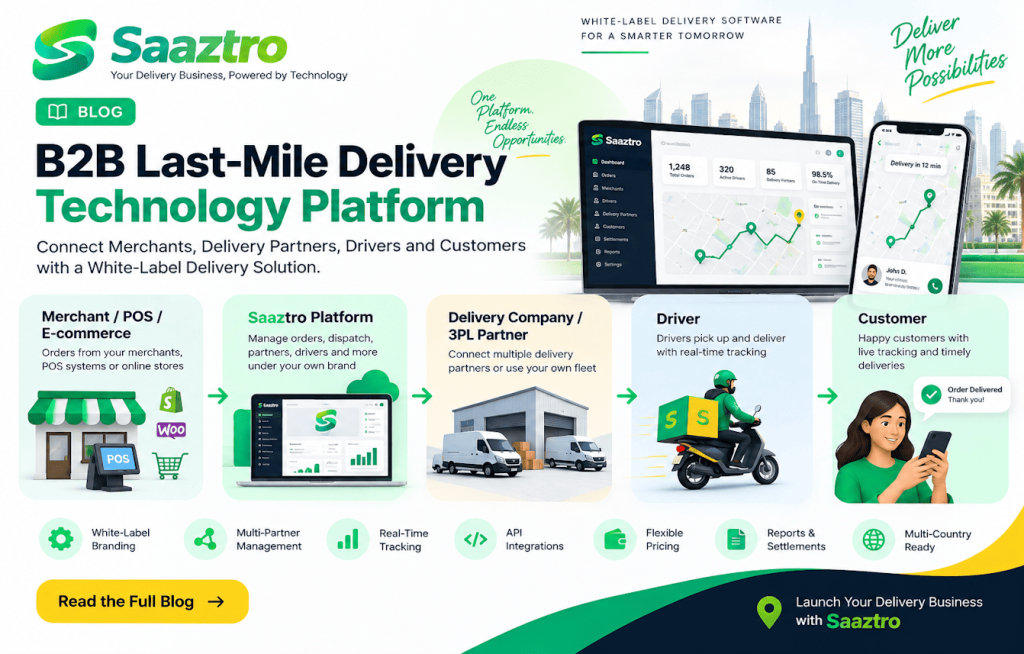
Merchant / POS / E-commerce → White-Label SaaS Platform → Delivery Company / 3PL → Driver → Customer
This model allows a company to launch its own branded delivery management business while using third-party delivery companies, contracted drivers, or its own fleet to complete deliveries.
What Is a B2B Last-Mile Delivery Platform?
A B2B last-mile delivery platform is a software system designed to manage the movement of orders from businesses to their final customers.
Unlike a consumer-facing delivery marketplace, the primary customer is usually a:
- Retail business
- E-commerce company
- Restaurant or food business
- Grocery company
- Pharmacy
- Distributor
- Courier company
- Logistics company
- 3PL provider
- Multi-store business
- Enterprise with its own delivery operation
The platform manages the technology layer between the business generating an order and the delivery resources completing that order.
How the Business Model Works
The complete delivery ecosystem can be structured into five major layers.
1. Merchant / POS / E-commerce
The merchant generates a delivery order through its existing business system.
Orders can enter the platform from:
- POS systems
- Shopify or other e-commerce platforms
- WooCommerce
- Custom websites
- Mobile applications
- ERP systems
- CRM systems
- Marketplace platforms
- Manual order entry
- API integrations
For example, an online retailer receives an order from its website.
Instead of manually calling a courier company, the order is automatically transferred to the delivery platform through an API.
2. White-Label SaaS Platform
The client operates the delivery technology under its own brand.
The platform provides:
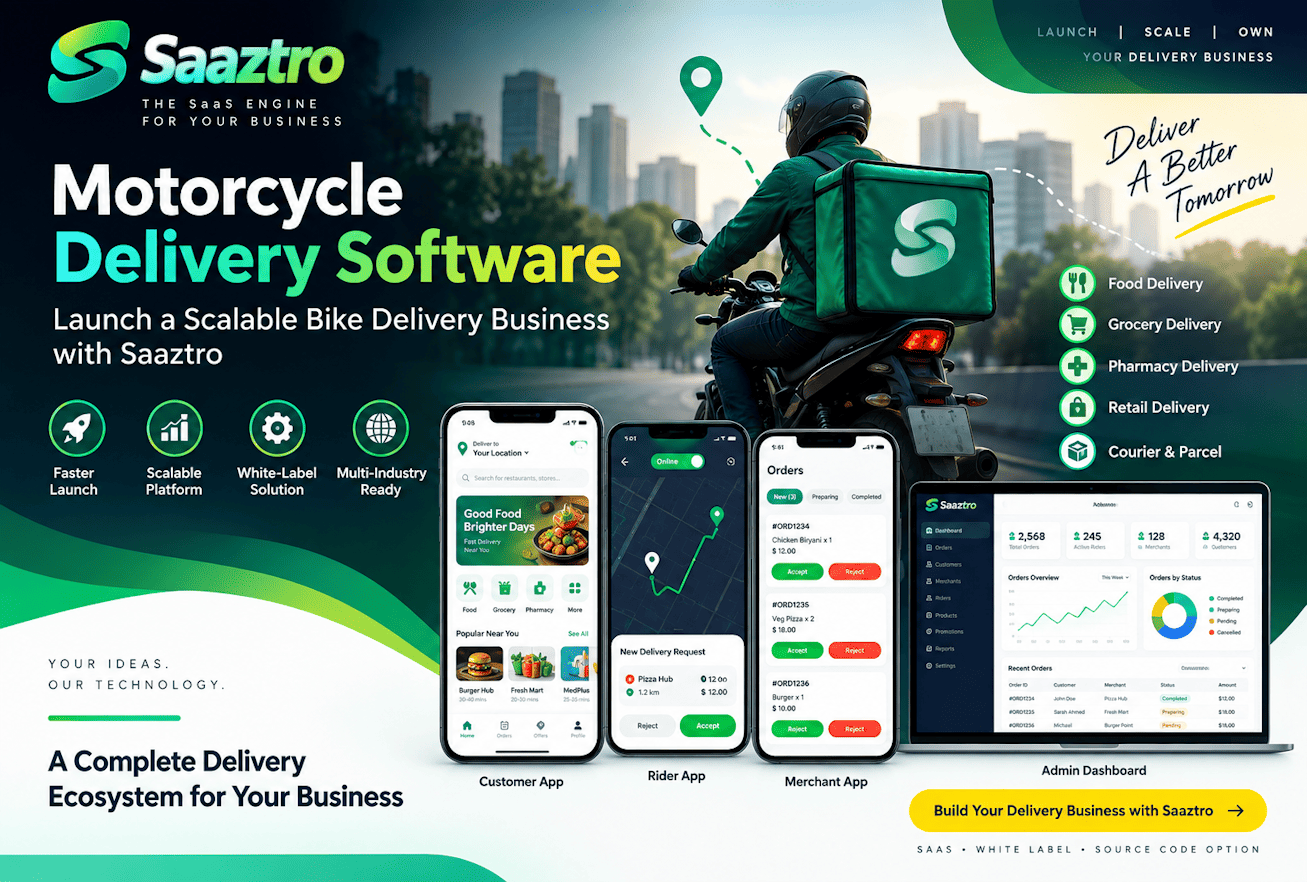
- Admin dashboard
- Merchant portal
- Delivery company portal
- Driver application
- Customer tracking
- Order management
- Dispatch management
- Delivery pricing
- Zone management
- Driver management
- Partner management
- API integrations
- Notifications
- Reports
- Settlement management
The white-label operator can use its own:
- Company name
- Logo
- Domain
- Branding
- Pricing
- Delivery zones
- Driver network
- Merchant onboarding process
This creates a technology-powered delivery business without requiring the operator to develop the complete platform from scratch.
3. Delivery Company / 3PL Partner
The white-label platform can connect multiple delivery companies or logistics partners.
For example:
Merchant → Platform → Delivery Partner A
or:
Merchant → Platform → Delivery Partner B
The operator can select a delivery company based on:
- Delivery zone
- Vehicle type
- Price
- Availability
- Service level
- Delivery time
- Partner capacity
This creates a multi-carrier or multi-3PL delivery model.
A delivery company can receive delivery requests through:
- Partner dashboard
- API
- Mobile application
- Automated dispatch integration
4. Driver
Once a delivery company accepts the order, the delivery is assigned to a driver.
The driver application can provide:
- New delivery requests
- Accept / reject delivery
- Pickup details
- Customer details
- Navigation
- Delivery instructions
- Proof of delivery
- OTP verification
- Photo proof
- Signature
- Call customer
- Chat
- Delivery status
- Earnings
- Delivery history
The driver updates the delivery status in real time.
Typical workflow:
Order Created → Assigned → Driver Accepted → Arrived at Pickup → Picked Up → Out for Delivery → Arrived at Customer → Delivered
5. Customer
The customer receives delivery notifications and can track the delivery.
Customer features can include:
- Tracking link
- Driver location
- Estimated arrival time
- Delivery status
- Driver contact
- OTP
- Delivery instructions
- Proof of delivery
- Order information
A branded tracking page can also be provided under the white-label company’s domain.
Example Business Flow
Consider an e-commerce company selling products in Dubai.
A customer places an order on the merchant’s website.
Step 1 — Order Creation
The e-commerce system creates the order.
Step 2 — API Integration
The order is automatically sent to the white-label delivery platform.
Step 3 — Delivery Pricing
The platform calculates the delivery charge based on factors such as:
- Pickup location
- Delivery location
- Distance
- Zone
- Vehicle type
- Delivery service
- Partner pricing
Step 4 — Dispatch
The platform identifies an available delivery company or driver.
Step 5 — Driver Assignment
The delivery partner assigns the order to a driver.
Step 6 — Pickup
The driver collects the package from the merchant.
Step 7 — Live Tracking
The customer receives a tracking link and can follow the delivery.
Step 8 — Proof of Delivery
The driver completes the delivery using OTP, signature, photo, or another configured proof-of-delivery method.
Step 9 — Settlement
The platform records the delivery charge and applicable commissions or partner fees.
Revenue Model for the White-Label Delivery Operator
The operator can build several revenue streams around the platform.
1. Delivery Margin
The merchant pays a delivery fee.
For example:
Merchant delivery charge: $10
Delivery partner cost: $7
Platform/operator margin: $3
The actual commercial arrangement can vary depending on the market and contracts.
2. Merchant Subscription
Merchants can pay a monthly or annual software subscription.
Example:
- Starter
- Growth
- Business
- Enterprise
The subscription can be based on:
- Number of orders
- Number of stores
- Number of users
- API usage
- Delivery volume
3. Per-Order Platform Fee
The operator can charge a fixed technology fee for each completed order.
Example:
$0.50 platform fee × 10,000 deliveries = $5,000
The exact pricing should be determined based on operating costs and the target market.
4. Delivery Partner Commission
Depending on the commercial agreement, the platform operator can earn a commission or service margin from delivery partners.
5. Enterprise Integration Fees
Enterprise customers may require integrations with:
- POS
- ERP
- WMS
- E-commerce platforms
- CRM
- Accounting systems
- Existing logistics software
These integrations can be priced separately.
Own Drivers vs Delivery Partners
A major advantage of this business model is that the platform does not have to depend on only one delivery model.
The operator can support:
Own Fleet
The business manages its own drivers.
Merchant → Platform → Own Driver → Customer
Delivery Agency
A third-party delivery agency handles deliveries.
Merchant → Platform → Delivery Agency → Driver → Customer
Multiple Delivery Companies
The platform can connect several logistics companies.
Merchant → Platform → Partner A / Partner B / Partner C → Driver → Customer
Hybrid Model
The operator can use its own drivers for selected zones and external delivery partners for other locations.
This creates flexibility as the delivery network grows.
Core Modules Required
A commercial B2B last-mile delivery platform should typically include the following modules.
Admin Dashboard
- Merchant management
- Delivery company management
- Driver management
- Order management
- Zone management
- Pricing rules
- Commission management
- Settlement management
- Reports
- Analytics
- Notifications
- API management
- Configuration
Merchant Portal
- Create delivery
- Import orders
- API orders
- Track deliveries
- View delivery history
- Manage addresses
- Manage users
- View invoices
- View delivery charges
- Download reports
Delivery Partner Portal
- Receive delivery requests
- Accept/reject jobs
- Assign drivers
- Monitor deliveries
- View earnings
- Manage drivers
- View settlement reports
Driver App
- Job management
- Navigation
- Pickup confirmation
- Delivery confirmation
- OTP
- Photo proof
- Signature
- Status updates
- Earnings
- Delivery history
Customer Tracking
- Tracking page
- Live status
- ETA
- Driver information
- Delivery notifications
- Proof of delivery
API-First Delivery Architecture
API integration is particularly important for a B2B delivery platform.
The platform should allow external systems to create and manage deliveries programmatically.
Typical API capabilities include:
Create Order
Get Order
Update Order
Cancel Order
Assign Driver
Get Delivery Status
Get Delivery Price
Track Delivery
Proof of Delivery
Webhooks
This allows merchants and enterprise systems to connect their existing software instead of manually entering every delivery.
White-Label Delivery Software
White-label functionality allows a logistics company, technology company, courier business, or entrepreneur to launch the platform under its own brand.
For example:
Your Technology Provider
↓
Client’s Brand
↓
Client’s Merchants
↓
Delivery Partners
↓
Drivers
↓
Customers
The end customer can interact with the client’s branded website, tracking page, notifications, and applications rather than the underlying technology provider.
Who Can Buy This Type of Platform?
A B2B last-mile delivery platform can be marketed to several buyer segments.
Courier Companies
Courier businesses can digitize dispatching, driver management, and customer tracking.
3PL Companies
Third-party logistics providers can manage multiple merchants and delivery operations.
E-commerce Logistics Companies
Companies specializing in e-commerce fulfillment can add last-mile delivery management.
Retail Groups
Large retailers can manage their own delivery network.
POS Companies
POS providers can add delivery capabilities to their existing software.
E-commerce Platforms
E-commerce platforms can integrate delivery directly into their merchant ecosystem.
Logistics Startups
Entrepreneurs can launch a branded delivery company without developing the entire technology stack themselves.
Read Also Best Last-Mile Delivery Software for Growing Businesses
Why Businesses Use a Delivery Technology Platform
The main objective is to create a centralized technology layer between order sources and delivery resources.
Instead of operating multiple disconnected systems:
POS + Excel + WhatsApp + Phone Calls + Separate Courier Systems
businesses can manage deliveries through:
One Delivery Management Platform
The platform can centralize:
- Orders
- Dispatch
- Drivers
- Delivery partners
- Pricing
- Tracking
- Notifications
- Proof of delivery
- Settlements
- Reporting
Build or Buy Last-Mile Delivery Software?
Developing a complete last-mile delivery ecosystem internally can require significant development across web applications, mobile applications, APIs, mapping, notifications, dispatching, security, reporting, and integrations.
A white-label SaaS solution provides an alternative for businesses that want to launch faster.
The business can focus on:
- Merchant acquisition
- Delivery partnerships
- Driver network
- Operations
- Pricing
- Customer relationships
while the technology platform provides the software infrastructure.
Read Also SaaS Food Delivery Software: Launch Your Own Business
Key Features to Look for When Buying Last-Mile Delivery Software
Businesses evaluating a platform should examine whether it supports:
- White-label branding
- Multi-merchant management
- Multi-delivery-company management
- Driver application
- Merchant portal
- API integration
- POS integration
- E-commerce integration
- Real-time tracking
- Automated dispatch
- Delivery zones
- Dynamic delivery pricing
- Proof of delivery
- OTP delivery
- COD management
- Driver earnings
- Partner settlements
- Analytics
- Webhooks
- Multi-language support
- Multi-currency support
- Scalable cloud infrastructure
Conclusion
A B2B last-mile delivery technology platform creates a connection between businesses generating orders and the delivery network responsible for completing them.
The core model is:
Merchant / POS / E-commerce
↓
White-Label Delivery SaaS Platform
↓
Delivery Company / 3PL / Own Fleet
↓
Driver
↓
Customer
This structure allows logistics companies, courier businesses, e-commerce platforms, retailers, and startups to build a branded delivery operation while supporting multiple order sources and delivery partners.
For businesses looking to launch or expand a delivery operation, the key consideration is not simply having a driver app. The platform should provide the complete ecosystem covering order intake, dispatch, delivery partners, drivers, tracking, proof of delivery, pricing, API integration, and settlement management.
Explore Last-Mile Delivery Solutions by Region
Looking for a last-mile delivery platform tailored to your market? Explore Saaztro’s regional solutions for businesses, logistics companies, and delivery operators:
- UAE: Last-Mile Delivery Software in UAE — Launch and manage a scalable delivery operation across the UAE.
- Dubai: Last-Mile Delivery Software in Dubai — Manage merchants, delivery partners, drivers, and customer deliveries from one platform.
- Saudi Arabia: Last-Mile Delivery Software in Saudi Arabia — Build a technology-powered last-mile delivery business for the Saudi market.
- Qatar: Delivery Management Software in Qatar — Streamline order dispatch, driver management, tracking, and delivery operations.
Saaztro helps businesses launch their own white-label delivery technology with merchant management, delivery partner integration, driver apps, real-time tracking, APIs, and delivery operations in one platform.
Frequently Asked Questions
What is a B2B last-mile delivery platform?
It is software that connects businesses generating delivery orders with drivers, courier companies, 3PL providers, and customers while managing dispatch, tracking, delivery status, and operational workflows.
What is white-label delivery software?
White-label delivery software allows a company to operate a delivery platform under its own brand, domain, applications, and business identity.
Can the platform connect multiple delivery companies?
Yes. A multi-partner architecture can allow the operator to connect several courier companies or 3PL providers and route deliveries according to configured business rules.
Can merchants connect their POS or e-commerce system?
Yes. API integrations can allow POS, e-commerce, ERP, and other systems to create delivery orders automatically.
Can a business use its own drivers?
Yes. The same platform can support an internal driver fleet as well as external delivery partners.
Can customers track their delivery?
Yes. A delivery tracking page or mobile experience can provide order status, driver information, location tracking, and delivery updates.
Is this suitable for a logistics startup?
Yes. A white-label platform can provide the technology foundation for launching a branded B2B delivery operation, while the business focuses on merchants, delivery partners, drivers, and operations.