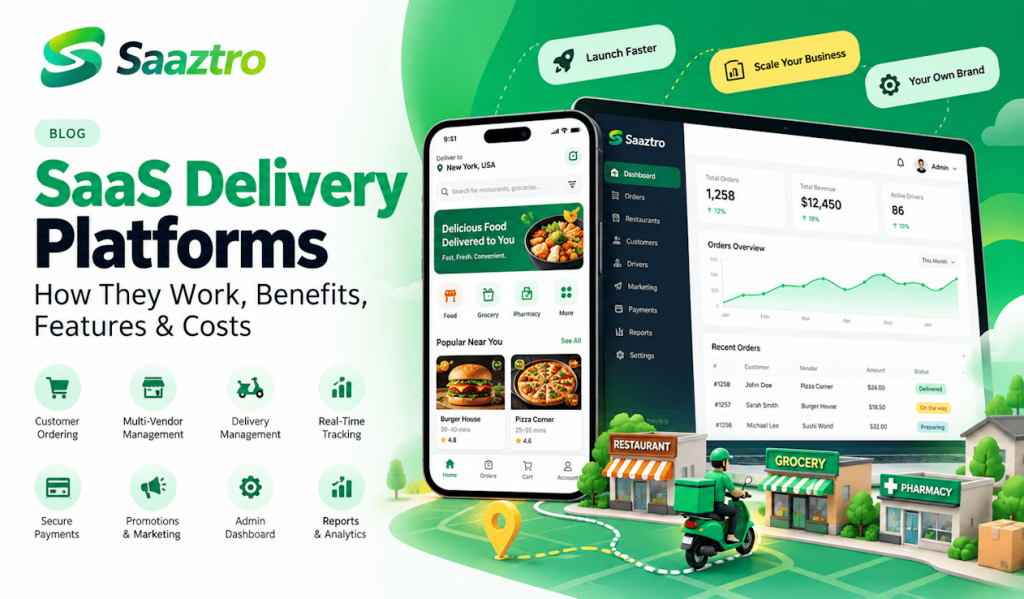
SaaS Delivery Platforms: How They Work, Benefits, Features & Costs
Launching a delivery business can be challenging. Entrepreneurs need more than a website or mobile app—they need a complete technology system for managing customers, vendors, orders, delivery partners, payments, tracking, and daily operations.
This is where SaaS Delivery Platforms can make a significant difference.
Instead of spending months and substantial development resources building a delivery platform from scratch, businesses can use a ready-to-launch SaaS solution and focus on acquiring customers, onboarding businesses, and expanding into new markets.
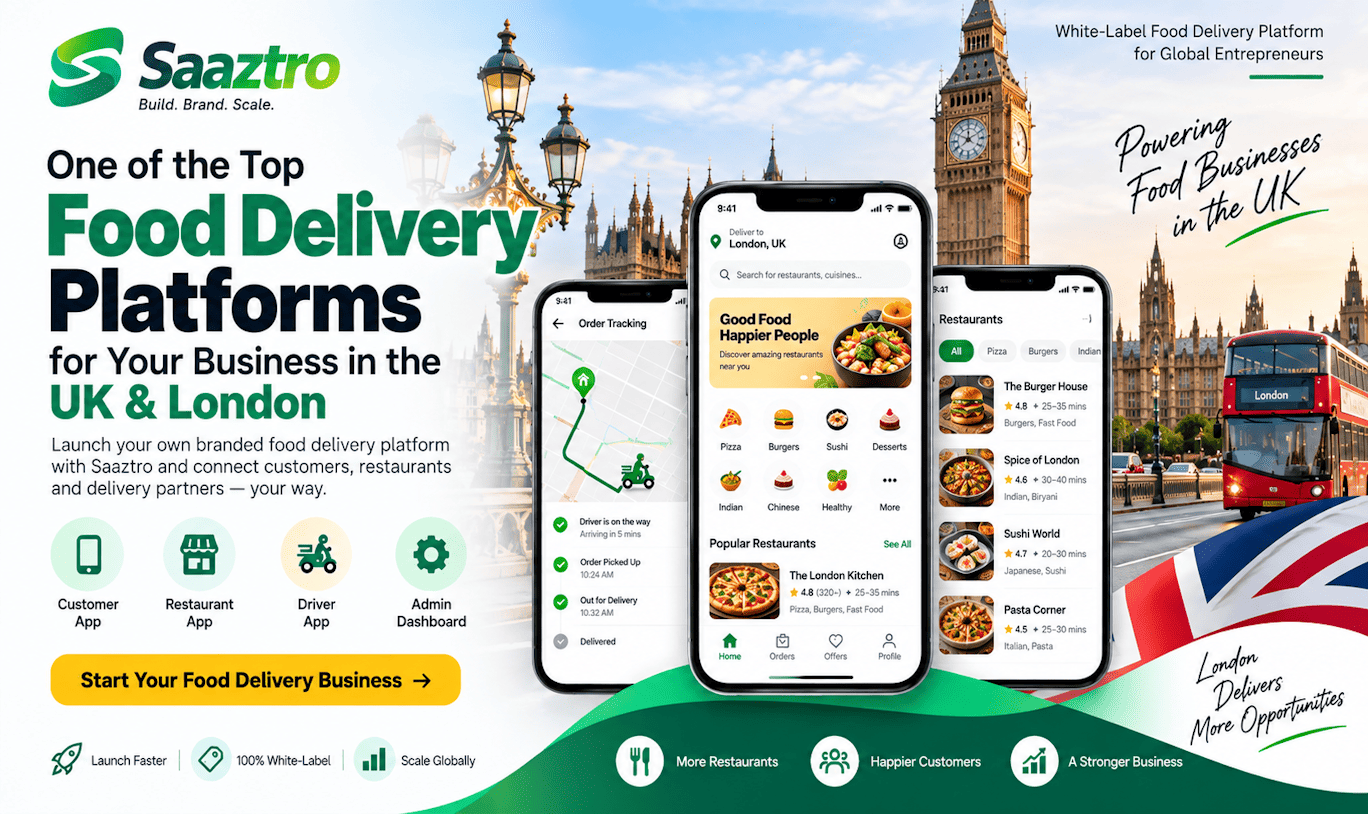
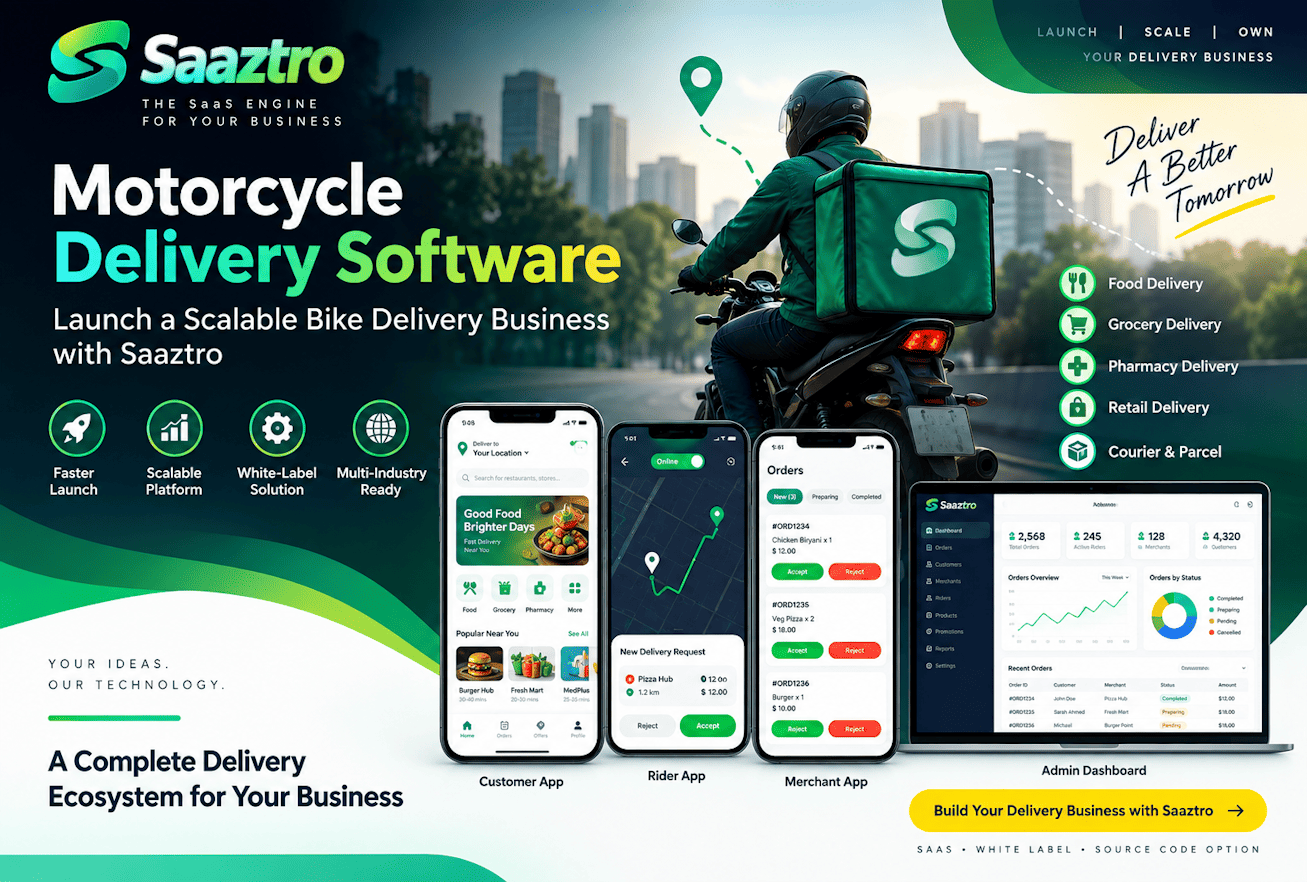
Saaztro provides a white-label SaaS delivery platform designed for entrepreneurs, startups, restaurants, grocery businesses, logistics companies, marketplaces, and enterprises looking to launch and scale their own delivery business.
What Are SaaS Delivery Platforms?
A SaaS delivery platform is a cloud-based software solution that provides the technology required to operate a delivery business.
SaaS stands for Software as a Service. NIST describes SaaS as a model where customers use applications running on cloud infrastructure without managing the underlying servers, operating systems, storage, and infrastructure themselves.
For a delivery business, this can include:
- Customer ordering applications
- Vendor or restaurant management
- Delivery partner applications
- Admin dashboard
- Online ordering website
- Order management
- Real-time delivery tracking
- Payment integration
- Promotions and coupons
- Delivery management
- Analytics and reporting
- Multi-location management
Rather than building every component independently, entrepreneurs can start with an existing technology foundation and configure it according to their business model.
Read Also SaaS Food Delivery Software: Launch Your Own Business
The Problem: Building a Delivery Platform From Scratch
Many entrepreneurs have a strong business idea but face a common technology challenge.
Building a delivery platform from the ground up requires multiple components:
1. High Development Requirements
A complete delivery ecosystem can require customer apps, vendor panels, driver apps, admin dashboards, APIs, payment systems, notifications, maps, and tracking.
2. Longer Time to Market
Custom software development can take months before the business is ready to onboard customers and vendors.
3. Ongoing Maintenance
Technology doesn’t stop at launch. Businesses need security updates, bug fixes, server management, application updates, integrations, and new features.
4. Scaling Complexity
A platform that works for one city may need significant changes when expanding to multiple cities, vendors, delivery partners, currencies, or languages.
5. Managing Multiple Systems
Without an integrated platform, businesses may end up using separate systems for orders, vendors, drivers, payments, and reporting.
These challenges can delay market entry and increase the technology workload for entrepreneurs.
The Solution: Launch With a SaaS Delivery Platform
A SaaS delivery platform provides a ready technology foundation that businesses can configure, brand, launch, and scale.
Saaztro is designed around this model.
With Saaztro, entrepreneurs can launch a branded delivery platform without having to develop the entire technology ecosystem from the beginning.
The platform can support food delivery, grocery delivery, logistics, multi-vendor marketplaces, and other on-demand delivery models.
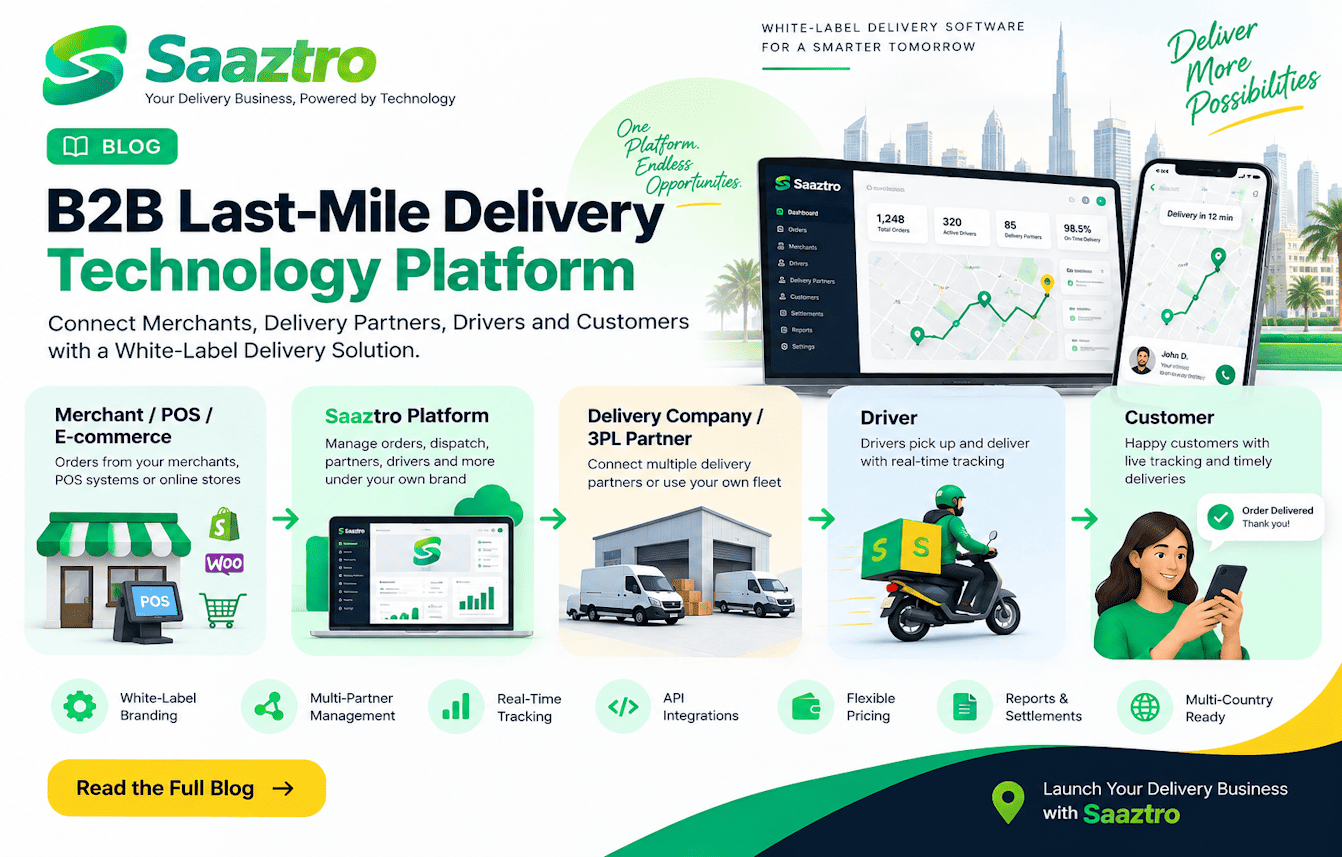
For example, a startup can create its own brand, onboard restaurants or vendors, register delivery partners, accept customer orders, manage deliveries, and monitor operations through a centralized system.
Businesses interested specifically in restaurant delivery can also explore our [Food Delivery Software] solution, while entrepreneurs building broader marketplace operations can consider [Multi-Vendor Delivery Software].
How Do SaaS Delivery Platforms Work?
The basic workflow is straightforward:
Step 1: Set Up Your Platform
Configure your business model, branding, service areas, delivery settings, payment options, and platform preferences.
Step 2: Launch Your Brand
Create a branded website and mobile applications for customers, vendors, and delivery partners.
Step 3: Onboard Vendors
Restaurants, grocery stores, retailers, or other businesses can be added to your marketplace.
Step 4: Accept Orders
Customers browse products or services, place orders, select payment methods, and receive order updates.
Step 5: Manage Deliveries
Orders can be assigned to delivery partners while administrators monitor delivery status and operations.
Step 6: Track and Scale
Businesses can use reports and analytics to understand operations and expand into additional locations.
This type of cloud-based approach allows businesses to focus on their customers and operations instead of managing every layer of infrastructure themselves. NIST identifies on-demand access and rapid provisioning as important characteristics of cloud computing.
Key Features of a Modern SaaS Delivery Platform
A business should evaluate more than the appearance of an app when choosing delivery software.
Customer Ordering
Customers should be able to browse businesses, view products or menus, place orders, save addresses, make payments, and track deliveries.
Vendor Management
Restaurants, stores, and other vendors need tools for managing products, menus, prices, availability, orders, and business information.
Delivery Partner App
Drivers need an application for receiving delivery assignments, navigation, order status updates, earnings, and delivery history.
Real-Time Tracking
Customers and administrators can follow deliveries from pickup through completion.
Payment Integration
A delivery platform should support relevant payment gateways and payment methods for the target market.
Promotions and Marketing
Coupons, discounts, referral campaigns, loyalty features, and promotional tools can help businesses attract and retain customers.
Multi-City and Multi-Vendor Support
Entrepreneurs planning to expand should consider whether their platform can support multiple vendors, locations, service areas, and operational teams.
Analytics and Reporting
Business owners need visibility into orders, revenue, vendors, customers, delivery performance, and overall platform activity.
Saaztro combines these capabilities into a unified delivery ecosystem rather than requiring businesses to assemble multiple unrelated systems.
Advantages of Using SaaS Delivery Platforms
Faster Launch
A ready SaaS platform can reduce the technology work required before launch, allowing entrepreneurs to focus on their business strategy.
Lower Initial Development Complexity
Instead of creating every component independently, businesses can start with an existing platform and configure it for their requirements.
Easier Business Expansion
A scalable platform can support expansion into new cities, vendors, business categories, and markets.
Centralized Management
Customers, vendors, orders, drivers, payments, and operational data can be managed through connected systems.
White-Label Branding
Businesses can launch under their own brand instead of presenting the software provider as the customer-facing business.
Technology and Infrastructure Support
The SaaS model reduces the need for businesses to independently manage every layer of their technology infrastructure.
Why Delivery Technology Matters
Delivery is increasingly connected to the overall customer experience.
Customers don’t simply evaluate what they order. They also care about availability, ordering convenience, delivery speed, tracking, communication, and reliability.
Research from McKinsey has highlighted how delivery options and perceived delivery quality can influence customer decision-making in e-commerce.
For entrepreneurs, this means delivery technology isn’t just an operational tool. It can become an important part of the business model.
A strong platform can help connect the customer experience with vendor operations and delivery management.
How Much Do SaaS Delivery Platforms Cost?
The cost depends on the platform, features, branding requirements, integrations, number of users, locations, and business model.
A business should consider:
- Initial setup costs
- SaaS subscription fees
- Mobile application requirements
- Payment gateway integrations
- Third-party API costs
- Hosting and infrastructure
- Custom development
- Maintenance and support
- Additional integrations
- Multi-location requirements
Instead of comparing platforms only by their subscription price, entrepreneurs should evaluate the total cost of launching and operating the business.
A platform that provides customer apps, vendor management, delivery management, administration, tracking, and integrations in one ecosystem may reduce the need for multiple technology vendors.
Who Should Use a SaaS Delivery Platform?
SaaS delivery platforms can be useful for:
- Entrepreneurs launching delivery startups
- Restaurant groups
- Cloud kitchens
- Grocery businesses
- Retail marketplaces
- Multi-vendor marketplaces
- Logistics companies
- Local delivery businesses
- Franchise networks
- Enterprise businesses
- Businesses expanding into new cities
For entrepreneurs looking to launch a food-focused business, Saaztro also provides White-Label Food Delivery Software with customer, vendor, delivery, and administration capabilities.
Businesses exploring instant delivery can also consider Quick Commerce Delivery Software for models involving rapid local fulfillment and dark-store operations.
Why Choose Saaztro?
Saaztro is built for businesses that want to launch, operate, and scale their own delivery platform.
The platform provides a white-label technology foundation for food, grocery, logistics, and multi-vendor delivery businesses.
Key capabilities include:
- Customer ordering applications
- Vendor and restaurant management
- Delivery partner applications
- Admin dashboard
- Real-time order tracking
- Payment integrations
- Delivery management
- Multi-vendor operations
- Multi-city support
- Multi-language capabilities
- Multi-currency support
- API integrations
- Marketing and promotional tools
Saaztro’s platform is designed to help businesses move from an idea to a functioning delivery operation without building the entire technology stack from scratch.
What Should You Look for When Choosing a SaaS Delivery Platform?
Before selecting a platform, evaluate:
- Business model compatibility – Does it support your delivery business?
- White-label capabilities – Can you operate under your own brand?
- Mobile applications – Are customer, vendor, and driver apps available?
- Scalability – Can the system support additional cities and vendors?
- Payment integrations – Does it support your target market?
- Tracking and delivery management – Can you manage the complete delivery lifecycle?
- APIs and integrations – Can you connect external services?
- Reporting – Can you measure business performance?
- Support and maintenance – What happens after launch?
- Total cost – What will the platform cost as your business grows?
Choosing technology based on long-term business requirements rather than only the initial price can help avoid expensive platform changes later.
Frequently Asked Questions
1. What is a SaaS delivery platform?
A SaaS delivery platform is cloud-based software that provides the technology required to operate a delivery business, including ordering, vendor management, delivery management, payments, tracking, and administration.
2. Can I launch my own delivery business using SaaS?
Yes. Entrepreneurs can use a white-label SaaS delivery platform to launch their own branded delivery business and configure the platform according to their operational requirements.
3. Can SaaS delivery software support multiple vendors?
Yes. Multi-vendor functionality allows businesses to onboard restaurants, grocery stores, retailers, or other vendors and manage them through a centralized platform.
4. Is SaaS delivery software suitable for food delivery?
Yes. Food delivery is one of the major use cases. A complete food delivery platform can connect customers, restaurants, delivery partners, payments, and administrators.
5. Can I expand my delivery platform to multiple cities?
A scalable SaaS delivery platform can support multi-city operations, subject to the platform’s architecture, configuration, infrastructure, and business requirements.
6. How much does a SaaS delivery platform cost?
Pricing varies based on features, subscription plans, setup requirements, integrations, branding, applications, and customization. Businesses should evaluate the complete cost of launching and operating the platform rather than looking only at the monthly or annual subscription.
Launch Your Delivery Business With Saaztro
Building a delivery business doesn’t have to begin with months of software development.
With the right SaaS Delivery Platform, entrepreneurs can start with a ready technology foundation, build their own brand, onboard vendors and delivery partners, accept orders, manage operations, and expand into new markets.
Saaztro helps businesses launch white-label delivery platforms for food, grocery, logistics, and multi-vendor marketplace models.
Explore Saaztro SaaS Delivery Platform and discover how you can launch your own branded delivery business.
About the Author
Saaztro Team
Saaztro is a technology platform focused on helping entrepreneurs, startups, restaurants, enterprises, and delivery businesses launch and scale branded delivery solutions. The Saaztro team works across food delivery, grocery delivery, logistics, multi-vendor marketplaces, and on-demand delivery technology.