Starting a food delivery business in Luxembourg can be a promising opportunity for entrepreneurs who want to build a local ordering brand, connect restaurants with customers, or launch a multi-restaurant marketplace. But how much does it actually cost?
The answer depends on your business model, delivery operations, technology, and whether you build software from scratch or use a ready-made platform.
For many entrepreneurs, the biggest mistake is spending too much on technology before validating the market. A better approach is to understand the costs, choose the right revenue model, and launch with a scalable food delivery software solution.
In this guide, we explain the main startup expenses, business models, revenue opportunities, and how Saaztro can help you launch your own branded delivery platform.
Is Luxembourg a Good Market for a Food Delivery Business?
Luxembourg has a digitally connected business environment and a diverse population, creating opportunities for online ordering services that offer convenience and reliable delivery. However, entrepreneurs should not assume that a new platform will automatically attract customers.
The opportunity is to identify a specific market gap—for example, better restaurant partnerships, direct ordering for independent restaurants, a focused delivery area, or a more attractive pricing model.
According to Eurostat’s digitalisation statistics, e-commerce remains an important sales channel for European businesses. This supports the broader case for restaurants and delivery businesses investing in online ordering, although Luxembourg-specific demand should be validated before launch.
The Main Problem: Starting a Delivery Platform Can Become Expensive
A traditional food delivery startup may need to invest in:
- Customer website and mobile applications
- Restaurant onboarding and management
- Driver applications and delivery tracking
- Payment gateway integration
- Hosting, security, and maintenance
- Marketing and customer acquisition
- Delivery staff, vehicles, or logistics partnerships
- Business registration, accounting, and legal compliance
Building every component from scratch can require a large upfront investment and a long development timeline.
Read Also for What Is a White Label Food Delivery App? Complete Guide for Restaurants
There is also a second challenge: restaurant owners and customers may not want another platform that adds high commissions without offering clear value.
This is why entrepreneurs should consider a business model that balances restaurant profitability, customer convenience, and sustainable platform revenue.
How Much Does It Cost to Start a Food Delivery Business in Luxembourg?
The following figures are indicative planning ranges in EUR, not fixed market prices. Actual costs depend on the scope of your platform, delivery model, integrations, and operational requirements.
| Expense | Estimated planning range |
|---|---|
| Business setup, accounting, and initial legal work | €500–€3,000+ |
| Branding, website, and launch materials | €500–€3,000+ |
| Custom food delivery app development | €15,000–€60,000+ |
| Ready-made or white-label platform setup | Often lower than custom development |
| Hosting, maintenance, and software | Monthly or annual subscription |
| Marketing and customer acquisition | €2,000–€10,000+ |
| Delivery operations | Depends on fleet, staffing, and partnerships |
| Payment, mapping, and third-party integrations | Depends on providers and usage |
A lean, software-first launch can be significantly more affordable than building a complete custom platform. However, the total business investment still depends on marketing, restaurant acquisition, delivery operations, and working capital.
1. Business Registration and Administration
Before launching, you should budget for business registration, accounting, contracts, insurance, and professional advice where required.
The exact requirements depend on your business structure and activities. For Luxembourg-specific administrative information, consult Guichet.lu’s official business portal.
2. Website and Mobile Applications
A professional restaurant ordering platform should make it easy for customers to browse restaurants, view menus, place orders, pay securely, and track deliveries.
You may need:
- Customer ordering website
- Android and iOS customer apps
- Restaurant dashboard
- Driver app
- Admin dashboard
- Order management and notifications
Custom development gives you maximum flexibility, but it also increases development time and cost.
3. Delivery Operations
Technology alone does not deliver food. You must decide whether to:
- Hire your own delivery drivers
- Partner with independent couriers
- Let restaurants handle delivery
- Offer a hybrid model
A restaurant-owned delivery model may require less operational investment, while a multi-restaurant marketplace with its own drivers may require more coordination and working capital.
4. Marketing and Customer Acquisition
Launching an app is not the same as building a business.
Your budget should include restaurant acquisition, local SEO, social media, launch promotions, referral campaigns, and customer retention.
A focused launch in one area or restaurant category can help you test demand before expanding.
Read Also for SaaS Food Delivery Software: Launch Your Own Business
Which Food Delivery Business Model Should You Choose?
Commission-Based Food Delivery Marketplace
You charge restaurants a percentage of each order.
Advantages:
- Revenue grows with order volume
- Easy to understand
- Suitable for multi-restaurant marketplaces
Challenge: High commissions can reduce restaurant profitability and make it harder to attract independent restaurants.
Commission-Free Food Delivery
You offer a commission-free food delivery model and earn through subscriptions, delivery fees, customer service fees, or other agreed revenue streams.
This can be attractive to restaurants that want more control over their margins and customer relationships.
However, commission-free does not mean cost-free. You still need to cover software, support, payment processing, delivery operations, and marketing.
Restaurant Subscription Model
Restaurants pay a monthly fee to use your subscription food delivery software or ordering platform.
This model can create predictable recurring revenue and may be suitable for businesses that want direct online ordering without paying a commission on every order.
Hybrid Revenue Model
A hybrid model combines subscriptions, delivery fees, optional commissions, premium features, or promotional services.
This gives you more flexibility to serve different restaurant segments.
How Saaztro Helps You Launch a Food Delivery Business
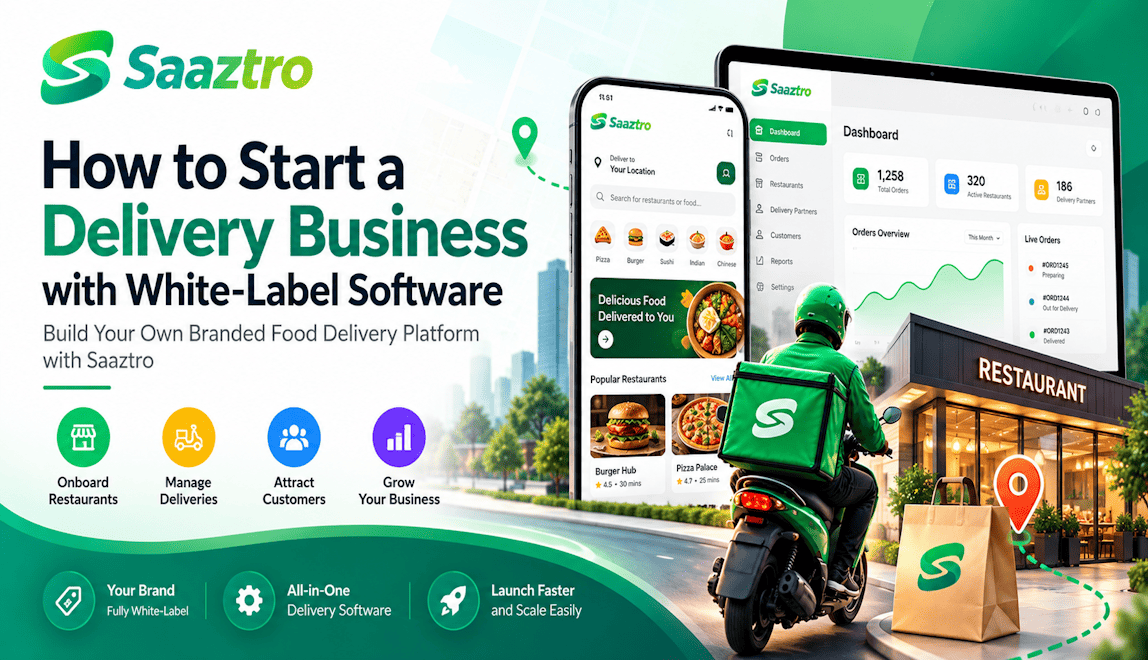
Instead of spending months developing every component from scratch, you can use Saaztro’s white label food delivery software to launch a branded ordering and delivery platform.
Saaztro provides a complete ecosystem for customer ordering, restaurant management, delivery operations, and administration.
Launch Your Own Branded Platform
With Saaztro, entrepreneurs can build a platform under their own brand with customer apps, restaurant panels, driver apps, and a centralized admin dashboard.
This helps you focus on restaurant partnerships, customer acquisition, and business growth rather than managing the entire software development process.
Manage Restaurants and Orders from One Dashboard
A centralized system helps you manage restaurants, menus, orders, customers, delivery partners, payments, and business operations.
This is especially useful when expanding from a small launch to multiple restaurants or locations.
Support Commission-Free and Subscription Models
Saaztro supports flexible business models, including subscriptions, commissions, and other revenue structures.
For entrepreneurs targeting independent restaurants, a commission free ordering system can be a useful positioning strategy when combined with a clear monthly subscription or service fee.
Offer a Better Customer Experience
A modern food ordering platform should provide:
- Restaurant discovery and search
- Menu browsing
- Secure checkout
- Order tracking
- Customer notifications
- Pickup and delivery options
- Promotions and loyalty features
These features help improve convenience and encourage repeat orders.
Why White Label Food Delivery Software Matters
Lower Development Complexity
A ready-made platform can reduce the time and technical effort required to launch compared with building every feature from zero.
Faster Market Validation
You can launch a focused version, onboard restaurants, collect feedback, and improve the business model before investing in extensive customization.
Scalable Business Infrastructure
As your business grows, you may need multi-restaurant management, delivery tracking, analytics, payment integrations, and additional operational features.
Saaztro is designed to support these requirements through a centralized delivery platform.
Better Brand Ownership
A white-label solution allows you to build your own customer-facing brand instead of relying entirely on another marketplace’s identity.
This can help you develop direct customer relationships and create a recognizable local delivery business.
Important Costs You Should Not Ignore
Before launching, calculate:
- Software subscription or development cost
- Payment processing fees
- Delivery partner payments
- Customer support
- Marketing and promotions
- Hosting and maintenance
- Restaurant onboarding
- Accounting and legal expenses
- Refunds, cancellations, and operational losses
For businesses operating across borders or selling taxable services in the EU, VAT obligations should also be reviewed. The European Commission’s VAT guidance explains the general VAT framework for businesses operating in the EU.
How to Launch Your Luxembourg Food Delivery Business
Step 1: Choose Your Target Market
Decide whether you want to serve restaurants, cloud kitchens, independent food businesses, or a broader marketplace.
Step 2: Select Your Revenue Model
Compare commission-based, commission-free, subscription, and hybrid models.
Step 3: Choose Your Technology
Evaluate whether custom development or white-label food delivery software is the better fit for your budget and timeline.
Step 4: Onboard Restaurants
Start with a focused group of restaurants and build strong operational relationships.
Step 5: Launch and Measure
Track orders, customer retention, restaurant performance, delivery times, and revenue.
Step 6: Expand Carefully
Once the model is working, expand into additional restaurants, delivery zones, and business features.
Final Thoughts
The cost of starting a food delivery business in Luxembourg depends on how much technology you build, how you manage delivery operations, and which revenue model you choose.
For entrepreneurs who want to launch faster and avoid the complexity of building a platform from scratch, white label food delivery software can be a practical starting point.
With the right business model, restaurant partnerships, and customer experience, you can build a delivery platform that creates value for both restaurants and customers.
Ready to launch your own food delivery platform in Luxembourg?
Explore Saaztro’s white label food delivery software or SaaS delivery platform to learn how you can build a branded restaurant ordering and delivery business.
Contact Saaztro today to discuss your business model, platform requirements, and launch strategy.
Frequently Asked Questions
1. How much money do I need to start a food delivery business in Luxembourg?
There is no single fixed amount. A lean software-first launch may require a much smaller technology investment than custom development, but you must also budget for marketing, restaurant acquisition, delivery operations, and working capital.
2. Is a commission-free food delivery business profitable?
It can be profitable if subscription fees, delivery charges, or other revenue streams cover your operating costs. The key is to balance restaurant affordability with sustainable platform revenue.
3. What is the best food delivery software for a startup?
The best solution depends on your business model, required features, budget, and growth plans. A white-label platform can be a practical option for entrepreneurs who want to launch faster without building everything from scratch.
4. Can I launch my own branded food delivery app?
Yes. A white-label food delivery platform can provide branded customer apps, restaurant dashboards, driver apps, and an admin panel under your business identity.
5. Should I build custom software or use a ready-made platform?
Custom software offers more flexibility but usually requires more time and investment. A ready-made platform may be better for validating your business model and launching sooner.
6. Can Saaztro support a subscription-based restaurant ordering business?
Saaztro supports SaaS and subscription-oriented delivery business models, including restaurant management, online ordering, delivery operations, and centralized administration.
Author: Saaztro Team
Saaztro helps entrepreneurs, restaurants, and businesses launch branded food delivery, grocery delivery, and multi-vendor ordering platforms with scalable white-label software.