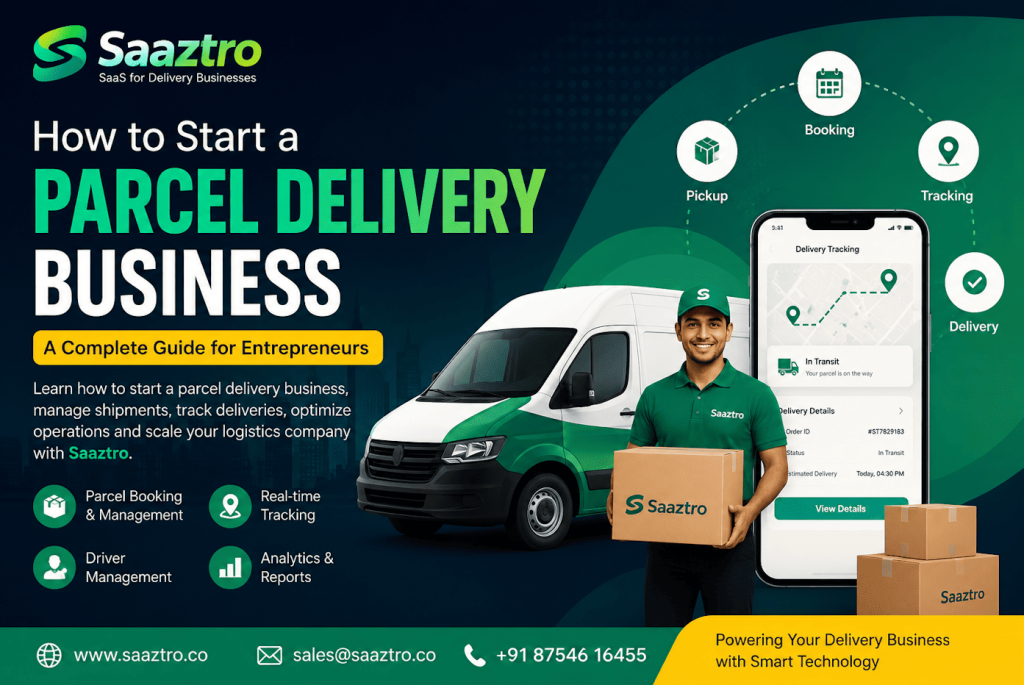
How to Start a Parcel Delivery Business in 2026: A Complete Guide for Entrepreneurs
Starting a parcel delivery business can be an attractive opportunity for entrepreneurs who want to build a scalable logistics company. The growth of e-commerce, local businesses, online sellers, and on-demand services continues to create demand for reliable pickup, transportation, tracking, and last-mile delivery.
However, launching a courier or parcel delivery company is more than buying vehicles and hiring drivers. A successful operation needs a clear business model, efficient delivery workflows, reliable tracking, customer communication, pricing controls, and technology that can scale as shipment volumes increase.
The World Bank’s Logistics Performance Index highlights tracking and tracing, logistics service quality, infrastructure, and shipment timeliness as important dimensions of logistics performance.
This guide explains how to start a parcel delivery business, what challenges to expect, and how entrepreneurs can use a white-label delivery platform such as Saaztro to launch and manage their own parcel delivery operation.
Why Start a Parcel Delivery Business?
Parcel delivery has become an essential part of modern commerce. Online stores, marketplaces, retailers, wholesalers, manufacturers, and individual customers all need dependable ways to move packages from one location to another.
UN Trade and Development (UNCTAD) notes that e-commerce logistics increasingly requires speed, scale, reliability, transparency, shipment tracking, and technology integration.
This creates opportunities for businesses that can provide:
- Same-day parcel delivery
- Local courier services
- Business-to-business deliveries
- E-commerce fulfillment
- Last-mile delivery
- Express delivery
- Scheduled pickup services
- Cash-on-delivery services
- Return and redelivery services
- Multi-city courier operations
For entrepreneurs, the opportunity is not only to operate a courier company but also to build a technology-enabled delivery business with multiple revenue streams.
Read Also : Last-Mile Delivery Operations Platform | Best Last-Mile Delivery Software for Growing Businesses
The Problem: Starting a Courier Business Is Operationally Complex
Many new courier businesses start with spreadsheets, phone calls, messaging applications, paper delivery records, and manually assigned drivers.
This approach may work for a small number of parcels, but operational problems appear as the business grows.
Common problems include:
- Manual parcel registration
- Delayed driver assignment
- Poor visibility of delivery status
- Customers repeatedly calling for updates
- Incorrect delivery charges
- Difficult cash-on-delivery reconciliation
- Failed delivery management
- Lack of proof of delivery
- Driver performance issues
- Difficult multi-city management
- Limited business reporting
- Increasing administrative workload
A parcel delivery company needs visibility across the complete shipment lifecycle, from booking and pickup to dispatch, tracking, delivery, and settlement.
This is where dedicated parcel delivery software becomes important.
How to Start a Parcel Delivery Business Step by Step
1. Choose Your Parcel Delivery Business Model
Before investing in technology or vehicles, define exactly what type of delivery company you want to build.
You could operate as:
- Local courier service
- Same-day delivery company
- E-commerce delivery provider
- B2B parcel delivery service
- Last-mile delivery company
- Multi-vendor logistics platform
- On-demand courier service
- Regional or multi-city courier network
Your business model determines your pricing, delivery zones, driver requirements, technology, and target customers.
2. Identify Your Target Customers
A clear customer segment makes it easier to design your services and pricing.
Potential customers include:
- E-commerce businesses
- Online retailers
- Small businesses
- Supermarkets
- Pharmacies
- Local merchants
- Manufacturers
- Wholesalers
- Corporate customers
- Individual customers
- Marketplace sellers
For example, an e-commerce-focused courier company may prioritize bulk parcel pickup, COD, returns, tracking, and API integration.
3. Define Your Delivery Areas
Start with a manageable service area instead of trying to cover an entire country immediately.
You can organize your delivery operation using:
- Cities
- Postal codes
- Delivery zones
- Distance ranges
- Pickup areas
- Serviceable locations
A technology platform can then automatically apply different delivery fees depending on the selected zone, parcel weight, distance, or service type.
Read Also : White Label Parcel Delivery Software: Complete Buyer’s Guide for Courier & Logistics Businesses
4. Create Your Courier Pricing Model
Your pricing strategy should cover operational costs while leaving room for profit.
Common pricing models include:
- Distance-based pricing
- Zone-based pricing
- Weight-based pricing
- Flat-rate delivery
- Express delivery charges
- Same-day delivery fees
- Pickup fees
- COD fees
- Return charges
- Redelivery charges
- Business account pricing
A flexible pricing engine is particularly important when your courier business expands across multiple cities.
5. Build Your Driver and Delivery Network
Drivers are central to the parcel delivery business.
You need a system for:
- Driver registration
- Driver verification
- Availability management
- Shipment assignment
- Navigation
- Delivery status updates
- Earnings tracking
- Proof of delivery
- Performance monitoring
Instead of manually coordinating every driver, a delivery platform can centralize these operations.
6. Provide Real-Time Parcel Tracking
Customers expect visibility after booking a shipment.
Your platform should allow customers to see statuses such as:
Booked → Pickup Assigned → Picked Up → In Transit → Out for Delivery → Delivered
Real-time tracking also helps your operations team identify delayed or problematic shipments.
Tracking and tracing is one of the dimensions included in the World Bank’s Logistics Performance Index, reinforcing the importance of shipment visibility in logistics operations. (LPI)
7. Implement Proof of Delivery
A modern courier business should not depend only on a driver’s verbal confirmation.
Proof of delivery can include:
- OTP verification
- Digital signature
- Delivery photograph
- Recipient confirmation
- Timestamp
- GPS location
This gives businesses stronger operational records and can help resolve delivery disputes.
8. Manage COD and Payments
Cash on delivery can be an important service for markets where customers prefer paying at delivery.
Your system should help manage:
- COD collection
- Driver cash balance
- Settlement records
- Delivery charges
- Customer payments
- Refunds
- Business invoices
Automating these processes reduces manual reconciliation and gives the business better financial visibility.
Why Parcel Delivery Software Is Important
Once parcel volumes increase, technology becomes an operational necessity rather than simply an optional feature.
A complete parcel delivery management system can connect customers, dispatchers, drivers, administrators, and business clients through one platform.
Saaztro’s [Parcel Delivery Software] provides parcel booking, pickup scheduling, dispatch, real-time tracking, proof of delivery, COD management, driver applications, customer applications, and administrative controls in a white-label platform.
What Saaztro Can Provide
With Saaztro, entrepreneurs can build a branded parcel delivery platform instead of developing the entire technology infrastructure from scratch.
The platform can include:
- Customer booking platform
- Customer mobile application
- Driver application
- Dispatcher dashboard
- Admin dashboard
- Parcel management
- Pickup scheduling
- Driver assignment
- Real-time tracking
- Route optimization
- Delivery status management
- Proof of delivery
- COD management
- Flexible delivery pricing
- Multi-city operations
- Multi-branch management
- Payment integrations
- API integrations
- Business reporting
Saaztro also offers [Parcel Delivery Features] covering shipment management, flexible pricing, wallet and COD management, mobile applications, and payment integrations.
Advantages of Using Saaztro to Launch Your Courier Platform
Launch Under Your Own Brand
Instead of operating through another company’s customer-facing platform, you can launch a branded parcel delivery business with your own identity.
Manage the Complete Delivery Workflow
From parcel booking and pickup to dispatch, tracking and final delivery, the platform can centralize your operational workflow.
Scale Across Multiple Cities
As your courier business grows, you can expand into new delivery zones, branches, cities, and operational regions.
Improve Customer Experience
Customers can book shipments, receive updates, track parcels, and view delivery information without repeatedly contacting your support team.
Reduce Manual Operations
Automation can reduce dependency on spreadsheets, phone calls, paper records, and manual driver coordination.
Build Multiple Revenue Streams
Your courier business can combine delivery fees, distance-based charges, zone pricing, COD fees, express delivery, business accounts, and other services.
Visist Also : Parcel Delivery Software in South Africa | Courier Delivery Software in Nigeria | Courier Software in Kenya | Saaztro
Expand Beyond Parcel Delivery
A parcel delivery company can eventually expand into broader logistics and delivery services.
Saaztro’s [Logistics & Courier Software] supports shipment management, fleet operations, hubs, drivers, routes, multi-city logistics, customer portals, analytics, and API integrations.
You can also explore [Last-Mile Delivery Software] if your business focuses on on-demand and final-mile delivery operations.
This creates a path from a small local courier operation to a larger logistics technology platform.
How Much Does It Cost to Start a Parcel Delivery Business?
The investment depends heavily on your business model and market.
Major cost categories can include:
- Business registration
- Vehicles or delivery partners
- Driver recruitment
- Insurance
- Fuel and transportation
- Staff
- Warehouse or hub space
- Marketing
- Customer support
- Technology
- Payment processing
- Maps and communication services
Starting with a delivery-partner model can reduce the need for a large owned fleet. Entrepreneurs can then invest progressively as shipment volumes grow.
Technology should be treated as part of the core operating infrastructure because manual systems become increasingly difficult to manage at scale.
A Practical Launch Strategy
A practical approach is to start with a focused geographic area and a specific customer segment.
Phase 1: Launch
Start with:
- One city or region
- Defined delivery zones
- Limited service types
- Small driver network
- Branded customer platform
- Centralized admin dashboard
Phase 2: Optimize
Track:
- Number of shipments
- Delivery success rate
- Average delivery time
- Driver utilization
- Revenue per shipment
- Failed deliveries
- COD reconciliation
- Customer retention
Phase 3: Scale
Once the model is validated:
- Add cities
- Add drivers
- Add business customers
- Introduce express delivery
- Expand delivery zones
- Add API integrations
- Introduce additional logistics services
Final Thoughts
Knowing how to start a parcel delivery business is only the first step. The real challenge is building an operation that can handle increasing parcel volumes without increasing administrative complexity at the same rate.
A successful courier business needs a strong business model, reliable drivers, transparent pricing, efficient dispatch, real-time tracking, proof of delivery, payment management, and scalable technology.
Saaztro gives entrepreneurs a way to launch a branded parcel delivery platform, manage day-to-day courier operations, and scale toward multi-city logistics without having to build an entire delivery technology ecosystem from the ground up.
If you are planning to launch your own courier, parcel, or last-mile delivery business, explore Saaztro’s [White-Label Delivery Platform] to understand how you can build and operate your own branded delivery ecosystem.
Frequently Asked Questions
1. How do I start a parcel delivery business?
Start by choosing your delivery business model, defining your service area, identifying target customers, establishing pricing, building a driver network, and implementing parcel delivery software for booking, dispatch, tracking, payments, and proof of delivery.
2. Is a parcel delivery business profitable?
A parcel delivery business can generate revenue through delivery fees, distance or zone-based pricing, express services, COD fees, business accounts, pickup charges, and other logistics services. Profitability depends on shipment volume, pricing, driver costs, fuel, operational efficiency, and customer acquisition.
3. Do I need software to start a courier business?
A very small courier operation may initially operate manually, but dedicated courier management software becomes increasingly valuable as shipment and driver volumes grow. It helps centralize bookings, dispatch, tracking, delivery status, payments, and reporting.
4. What features should parcel delivery software have?
Important features include parcel booking, pickup scheduling, driver management, dispatch, real-time tracking, delivery status updates, proof of delivery, COD management, flexible pricing, customer notifications, analytics, and mobile applications.
5. Can I launch my own branded courier platform?
Yes. A white-label courier platform allows entrepreneurs to operate delivery services under their own brand. Saaztro provides white-label parcel delivery capabilities with customer apps, driver apps, dispatcher tools, and an administrative platform.
6. Can a parcel delivery business expand into other delivery services?
Yes. Once the courier network, drivers, customer base, and technology infrastructure are established, a business can expand into last-mile delivery, e-commerce logistics, food delivery, grocery delivery, or other on-demand services.
Start Your Parcel Delivery Business with Saaztro
If you are an entrepreneur, logistics operator, or business owner planning to launch your own courier or parcel delivery company, Saaztro can help you move from business idea to a branded delivery platform.
Build your brand. Manage your deliveries. Scale your logistics business.
[Explore Saaztro Parcel Delivery Software]
Related Saaztro Resources
- Parcel Delivery Software
- Logistics & Courier Software
- Parcel Delivery Features
- Last-Mile Delivery Software
- White-Label Delivery Platform
Author
Saaztro Team
Saaztro helps entrepreneurs, startups, logistics companies, and enterprises launch and scale white-label delivery platforms across parcel delivery, courier, last-mile, food, grocery, and other on-demand delivery businesses.