
Imagine a customer ordering groceries, fresh vegetables, snacks or everyday essentials and receiving them at their doorstep within just 10 minutes.
This is no longer just a futuristic concept. Quick commerce (Q-commerce) is transforming how people shop, creating new opportunities for supermarkets, grocery retailers, restaurants and entrepreneurs.
Consumers increasingly expect convenience, fast delivery and real-time order updates. Traditional delivery models that take several hours or even days are facing competition from businesses offering hyperlocal, on-demand delivery.
But building a successful 10-minute delivery business requires more than hiring delivery executives and launching a mobile application. It requires an efficient operational model, strategically located inventory, reliable delivery management and the right technology.
In this guide, we explain how to build a 10-minute delivery business, the challenges involved and how quick-commerce software can help you launch and scale your own delivery operation.
1. What Is Quick Commerce and Why Is It Growing?
Quick commerce is a business model that focuses on delivering everyday products within a very short period, typically between 10 and 30 minutes.
Unlike traditional e-commerce, where products are shipped from centralized warehouses, quick-commerce businesses use strategically located stores, dark stores or local fulfillment centers to serve customers in nearby areas.
Common product categories include:
- Groceries and fresh vegetables
- Fruits and dairy products
- Snacks and beverages
- Household essentials
- Personal care products
- Bakery and ready-to-eat food
- Pharmacy and daily necessities, where legally permitted
The business model focuses on three essential elements:
- Local inventory: Products are stored close to customers.
- Fast order fulfillment: Orders are picked, packed and prepared quickly.
- Efficient last-mile delivery: Delivery executives transport orders through optimized local routes.
According to research published by McKinsey, proximity-based fulfillment and dark-store operations are important components of efficient quick-commerce delivery.
For entrepreneurs, this creates an opportunity to establish a local delivery brand instead of depending entirely on third-party marketplaces.
2. The Problem: Why Traditional Delivery Businesses Struggle
Starting a delivery business may appear straightforward, but managing operations efficiently becomes challenging as order volumes increase.
Many supermarkets and independent retailers face the following problems.
2.1 Slow Order Processing
Traditional ordering systems often rely on phone calls, WhatsApp messages or manual order entry.
Employees must confirm product availability, calculate prices, prepare orders and coordinate delivery manually.
This creates unnecessary delays.
2.2 Poor Inventory Visibility
Inventory management becomes difficult when businesses operate multiple stores or warehouses.
Without centralized inventory visibility:
- Customers may order unavailable products.
- Staff may struggle to identify available stock.
- Inventory updates may be delayed.
- Businesses may experience cancellations and customer dissatisfaction.
2.3 Inefficient Delivery Management
Managing delivery executives manually becomes increasingly difficult when multiple orders arrive simultaneously.
Businesses need to assign orders, monitor delivery progress and communicate with drivers efficiently.
Without a centralized delivery management system, operational costs can increase.
2.4 Difficulty Managing Multiple Stores
Businesses expanding into multiple locations need a system that can manage individual branches, products, orders and delivery operations.
A traditional single-store ordering application may not provide the flexibility required for expansion.
2.5 High Technology Development Costs
Building separate customer applications, delivery applications, restaurant or store management panels and administrative systems from scratch can require significant investment.
For startups, this can delay market entry and consume valuable capital.
The solution is to combine a suitable business model with reliable quick-commerce software that connects customers, stores, administrators and delivery executives.
3. How to Build a 10-Minute Delivery Business: Step-by-Step
Launching a quick-commerce business requires careful planning. Here are the essential steps.
Step 1: Identify Your Target Market
Start by identifying the customers and geographical areas you want to serve.
Potential business opportunities include:
- Neighborhood grocery delivery
- Supermarket delivery
- Multi-vendor grocery marketplaces
- Restaurant and food delivery
- Daily essentials delivery
- Local convenience store delivery
- Specialized product delivery
Instead of launching across an entire city immediately, start with a smaller geographical area.
A focused delivery zone makes inventory management, delivery coordination and customer acquisition easier.
Step 2: Choose Your Fulfillment Model
Your fulfillment strategy determines how quickly orders can reach customers.
There are three common approaches.
Dark Store Model
A dark store is a small fulfillment center dedicated to online orders. Customers place orders through an application, and employees pick and pack products for delivery.
This model provides greater control over inventory and order processing.
Existing Supermarket Model
Existing supermarkets can use their physical stores as local fulfillment centers.
When customers place orders, store employees prepare the products and assign delivery executives.
This approach can reduce the initial investment required to establish separate facilities.
Multi-Vendor Marketplace Model
You can onboard multiple local supermarkets, grocery shops and retailers onto a single platform.
Customers browse products from nearby stores, place orders and receive deliveries through the platform.
This model is particularly useful for entrepreneurs who want to build a marketplace without owning all the inventory.
Step 3: Build Your Technology Infrastructure
Technology is the backbone of every successful quick-commerce business.
A professional quick-commerce platform should connect all business operations through a centralized system.
Essential components include:
Customer Application
- Customer registration and login
- Product browsing and search
- Shopping cart and checkout
- Multiple payment options
- Order tracking
- Order history
- Offers and promotional campaigns
Store or Restaurant Application
- Store registration and management
- Product and menu management
- Inventory and availability management
- Order acceptance and processing
- Order preparation updates
- Sales and order reports
Delivery Executive Application
- Driver registration
- Order assignment
- Pickup and delivery management
- Navigation and location tracking
- Order status updates
- Delivery history
Admin Dashboard
- Customer management
- Store and branch management
- Product and category management
- Order monitoring
- Delivery executive management
- Commission and payment management
- Promotional campaigns
- Business analytics and reporting
Investing in the right quick-commerce software helps automate these operations and reduces dependence on manual processes.
Step 4: Implement Smart Inventory Management
Inventory accuracy is essential for delivering orders quickly.
Your system should help businesses monitor product availability and update stock information as orders are processed.
Important inventory capabilities include:
- Real-time or near-real-time stock updates
- Product availability management
- Branch-level inventory
- Product variations and pricing
- Low-stock monitoring
- Inventory reports
- Product categorization
For businesses operating multiple supermarkets or dark stores, inventory visibility across locations can improve order fulfillment decisions.
Step 5: Establish an Efficient Delivery Network
Even with excellent technology, delivery operations can become a bottleneck without proper planning.
Consider the following strategies:
- Define smaller delivery zones.
- Position fulfillment centers close to customers.
- Maintain an adequate delivery workforce.
- Assign orders based on location and availability.
- Use GPS-based tracking.
- Monitor pickup and delivery times.
- Analyze delivery performance regularly.
Remember that a 10-minute delivery promise should be based on actual operational capacity.
Do not advertise delivery times that your business cannot consistently achieve.
Step 6: Launch in One Location and Expand Gradually
Start with one neighborhood or a small delivery zone.
Monitor important performance indicators:
- Average order preparation time
- Average delivery time
- Orders completed per day
- Order cancellation rate
- Average order value
- Repeat customer rate
- Delivery cost per order
- Inventory accuracy
Once operations become predictable and financially sustainable, expand into additional delivery zones and branches.
4. Why Quick-Commerce Software Is Important
Building a quick-commerce business without an integrated technology platform can create operational problems as the business grows.
A dedicated quick-commerce solution connects the entire delivery ecosystem.
Here is why investing in the right software matters.
Centralized Business Management
Manage multiple stores, customers, orders and delivery executives from one administrative dashboard.
Faster Order Processing
Automated order notifications and organized order workflows help stores process incoming orders efficiently.
Better Customer Experience
Customers can browse products, place orders, make payments and track deliveries through dedicated applications.
Improved Delivery Visibility
GPS-based tracking and delivery status updates help administrators and customers monitor order progress.
Business Scalability
A suitable platform allows businesses to expand from a single store into a multi-store or multi-vendor delivery operation.
Reduced Operational Complexity
Instead of managing different tools for ordering, stores and deliveries, businesses can coordinate essential activities through one integrated platform.
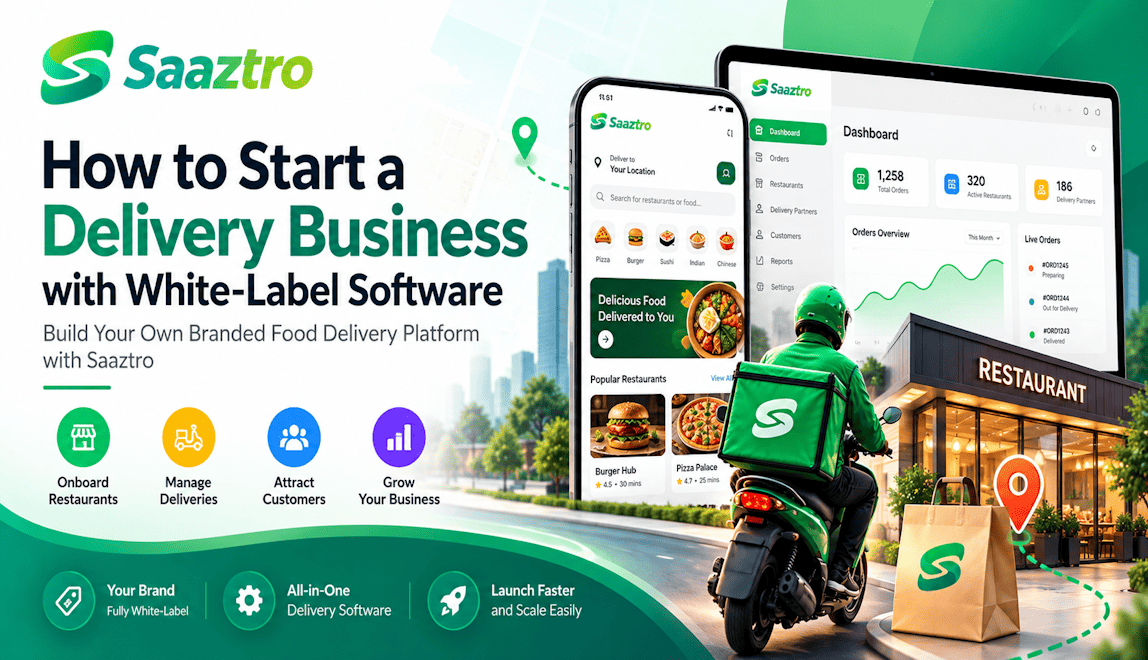
Read Also How to Start a Delivery Business with White-Label Software
5. How Saaztro Helps You Launch Your Quick Commerce Business
Building an entire delivery ecosystem from scratch can be expensive and time-consuming.
This is where Saaztro can help.
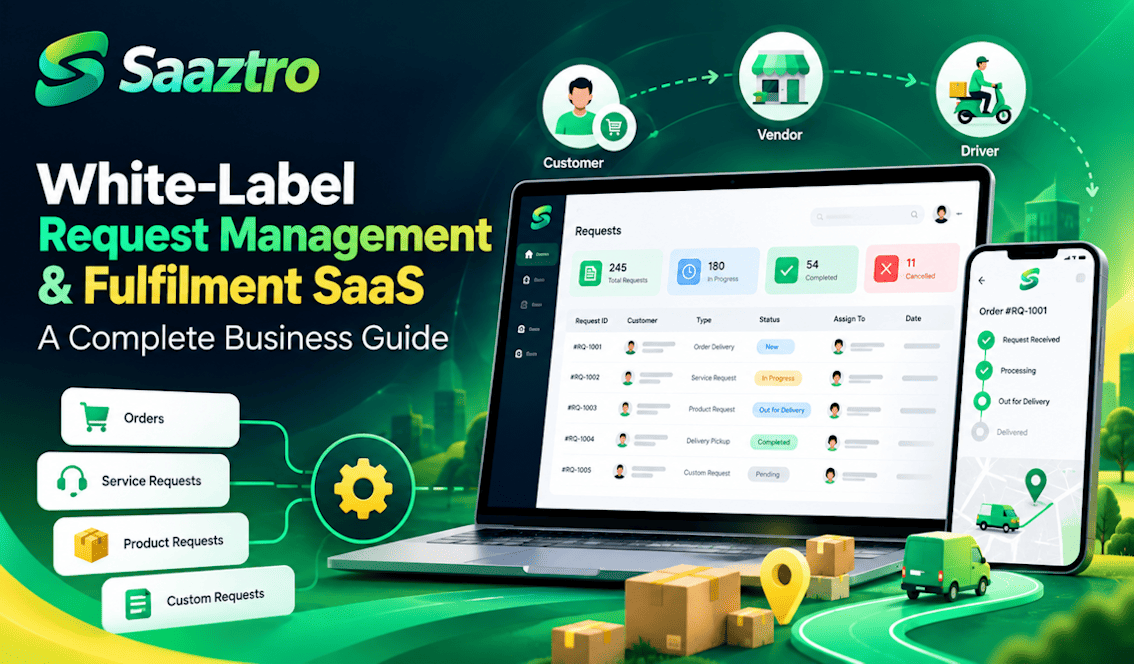
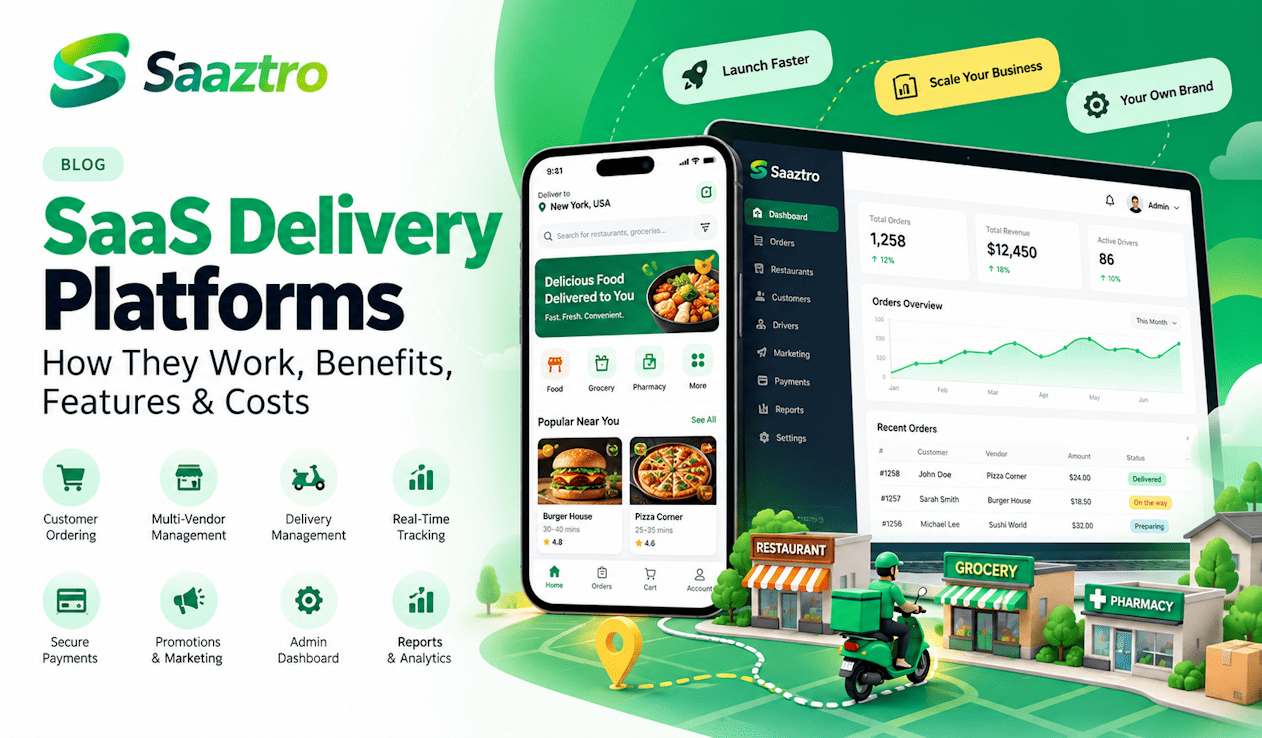
Saaztro is a white-label SaaS food ordering and delivery platform designed for entrepreneurs, startups, restaurants, supermarkets and businesses looking to establish their own branded ordering and delivery ecosystem.
Instead of investing in multiple applications and management systems independently, businesses can leverage an integrated platform with customer, store, delivery and administrative components.
Key Saaztro Capabilities
1. Customer Application
Launch your own branded customer application where users can discover stores, browse products, place orders and track deliveries.
2. Store Management Application
Allow stores and business operators to manage products, menus, incoming orders and order preparation.
3. Delivery Executive Application
Manage delivery operations through a dedicated application with order assignments, pickup and delivery workflows, and real-time order tracking.
4. Centralized Admin Dashboard
Monitor stores, customers, orders, delivery executives and business operations from a centralized administration panel.
5. Multi-Store Management
Manage multiple stores and organize business operations through a centralized platform.
6. Inventory and Product Management
Manage product catalogs, pricing, availability and inventory-related operations.
7. Real-Time Order Tracking
Provide better visibility into delivery progress and improve communication between customers, stores and delivery executives.
8. Marketing and Promotional Tools
Use promotional campaigns and customer engagement features to attract customers and encourage repeat purchases.
9. Multi-Language and Multi-Currency Support
Build a delivery platform for different geographical markets with support for multiple languages and currencies.
Can You Build a 10-Minute Grocery Delivery Business with Saaztro?
Yes, Saaztro can provide the core ordering and delivery infrastructure for a quick-commerce business.
However, achieving consistent 10-minute delivery also depends on your physical operations, including:
- Store or dark-store location
- Product availability
- Order preparation speed
- Delivery executive availability
- Delivery distance
- Traffic and local infrastructure
Businesses can configure their operating model around smaller delivery zones and local fulfillment centers.
Depending on your requirements, the platform can be evaluated and customized for your specific quick-commerce workflows, including supermarket and multi-store operations.
Your business owns the brand and customer relationship while Saaztro provides the technology foundation.
Explore the platform: Saaztro – White-Label Food Ordering and Delivery Software.
6. Advantages of Starting a Quick Commerce Business
The quick-commerce business model offers several opportunities for entrepreneurs.
Growing Consumer Demand
Customers increasingly value convenience and faster access to everyday products.
A reliable local delivery service can attract customers who prefer ordering from their smartphones.
Multiple Revenue Opportunities
Depending on your business model, revenue can come from:
- Product sales margins
- Store subscriptions
- Delivery charges
- Vendor commissions
- Promotional listings
- Advertising opportunities
Local Market Expansion
Businesses can begin with one delivery zone and gradually expand into nearby neighborhoods.
Strong Customer Retention Potential
Customers who regularly purchase groceries and household essentials may place repeat orders.
Consistent service quality, product availability and transparent delivery updates can encourage loyalty.
Independent Brand Ownership
With a white-label delivery platform, businesses can operate using their own brand identity, applications and customer-facing experience instead of relying entirely on established third-party marketplaces.
7. Important Challenges to Consider Before Launching
Although quick commerce presents attractive opportunities, entrepreneurs must consider the economics of the business.
Delivery Costs: Frequent small orders can increase delivery expenses. Establish minimum order values or suitable delivery charges where necessary.
Inventory Investment: Maintaining stock across multiple locations requires working capital and careful demand forecasting.
Product Availability: Stock accuracy is important to prevent cancellations and substitutions.
Delivery Time Commitments: Start with realistic delivery promises and improve performance as your operations mature.
Customer Acquisition: Invest in local digital marketing, referral programs and customer retention campaigns.
Technology Reliability: Choose a platform that can support your business operations as order volumes and store locations increase.
The objective should not simply be delivering within 10 minutes. It should be delivering quickly while maintaining customer satisfaction and sustainable unit economics.
8. Frequently Asked Questions (FAQs)
What is quick-commerce software?
Quick-commerce software is a technology platform that enables businesses to manage online ordering, inventory, stores, order processing and last-mile delivery. It supports businesses offering fast delivery of groceries, food and everyday essentials.
How much investment is required to start a 10-minute delivery business?
Investment depends on the business model, location, inventory requirements, delivery workforce and technology infrastructure.
A marketplace model using existing local stores may require less initial investment than an inventory-led business operating multiple dark stores.
Can I start a quick-commerce business without owning a warehouse?
Yes. You can partner with existing supermarkets, grocery shops and local retailers through a multi-vendor marketplace model.
This allows you to build a delivery business without necessarily maintaining your own inventory.
Do I need separate applications for customers and delivery executives?
Dedicated customer and delivery applications are recommended because they serve different operational purposes. Store management and administration interfaces are also important for coordinating orders.
Can Saaztro be used for supermarket and grocery delivery?
Saaztro provides customer, store, delivery and administration components that can support food and grocery ordering businesses. Specific supermarket inventory, warehouse and quick-commerce workflows should be evaluated against your operational requirements.
Can I launch my own branded delivery application?
Yes. Saaztro offers a white-label platform that allows businesses to establish their own branded ordering and delivery ecosystem.
9. Final Thoughts: Build Your Own Quick Commerce Business with the Right Technology
The future of local retail is increasingly connected to convenience, digital ordering and efficient last-mile delivery.
Whether you operate a supermarket, manage multiple grocery stores or plan to launch a new delivery startup, quick commerce offers an opportunity to build a scalable business around customers’ everyday needs.
However, success depends on more than speed. You need the right fulfillment strategy, accurate inventory management, efficient delivery operations and reliable technology.
With the right quick-commerce software, you can simplify operations, establish your own delivery brand and expand into new markets without building every technology component from scratch.
Ready to Launch Your Own Quick Commerce Platform?
Build your own branded food, grocery and local delivery ecosystem with Saaztro.
Get a white-label delivery solution with customer applications, store management, delivery applications and a centralized admin dashboard.
Start building your delivery business today.
Visit www.saaztro.co or contact the Saaztro team to request a personalized product demonstration.
About the Author
Saaztro Team
The Saaztro Team specializes in digital ordering, food delivery technology, white-label SaaS platforms and on-demand delivery solutions. We help entrepreneurs, startups, restaurants and retail businesses build and manage their own branded ordering and delivery ecosystems.
Our goal is to simplify digital transformation and help businesses launch scalable delivery platforms with the right technology.